The Mind of the Iron Wall

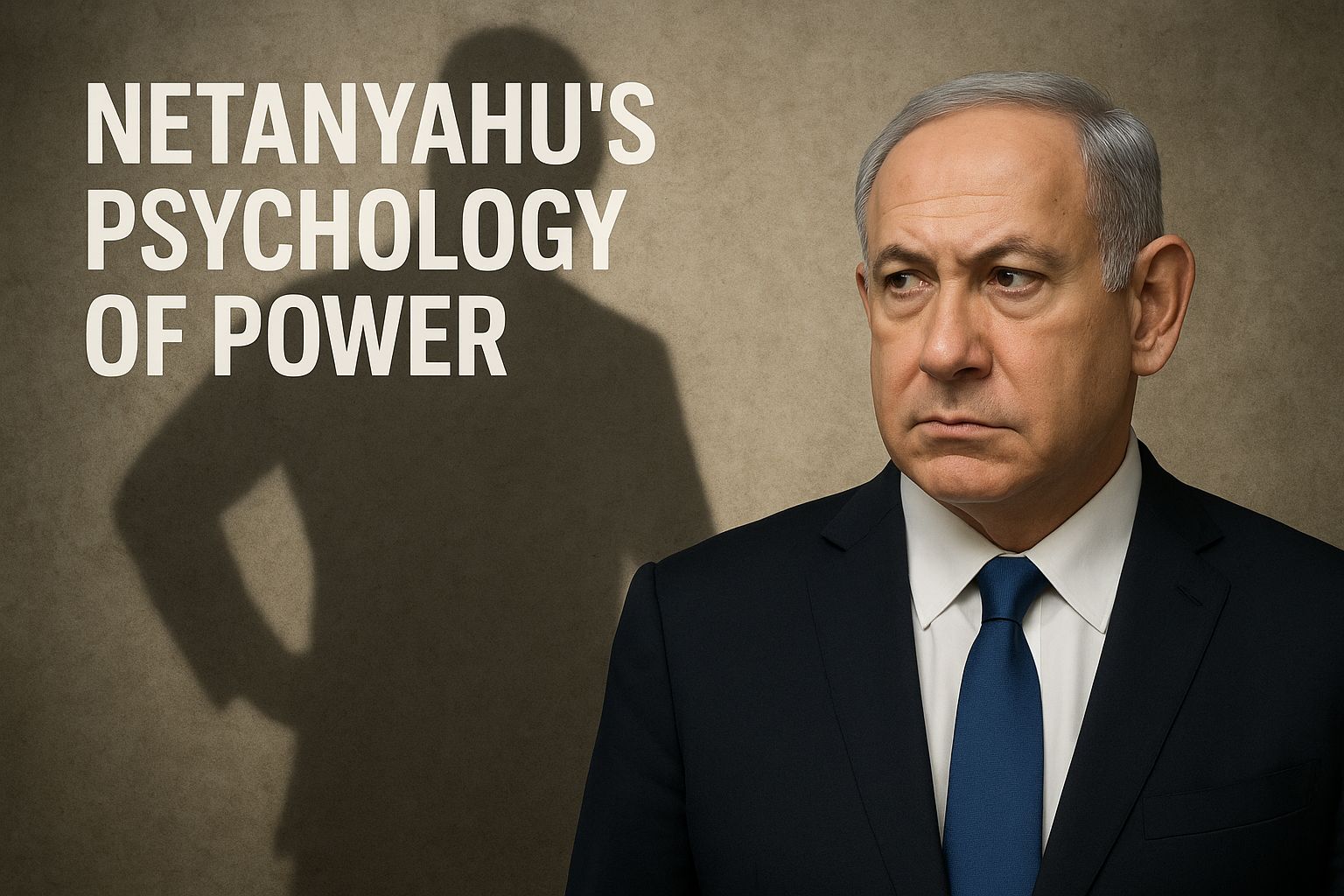
The Mind of the Iron Wall: Is Peace Possible Under the Shadow of Netanyahu’s Power Psychology?
In recent years, Israeli politics has been marked by Prime Minister Benjamin Netanyahu, who stands not merely as a political figure but as a carrier of a theopolitical ideology. Netanyahu’s political persona can be viewed as the contemporary projection of Revisionist Zionism. His psychology of power is rooted in the intellectual legacy of Vladimir Jabotinsky’s 1923 essay “The Iron Wall.” According to this doctrine, security, existence, and identity can only be preserved through absolute power. In his leadership style, “peace” is not an ideal but rather a mutable security strategy defined by the continuity of threats.
Since October 7, 2023, Israel has escalated its war with Hamas to an unprecedented level, launching what many regard as one of the largest genocides in history against millions of people. Under U.S. President Donald Trump’s peace plan for Gaza, a ceasefire agreement was reached within a vague framework. It is crucial to emphasize that this ceasefire is not a peace agreement. In military terms, it can be defined as an operational ceasefire—designed to open humanitarian aid corridors, enable prisoner exchanges, facilitate the evacuation of the wounded and civilians, and lay the groundwork for negotiations.
Following the ceasefire in Gaza, the first phase of Trump’s three-stage peace plan continues to be implemented. Trump had proposed a 20-point plan to end the war in Gaza; several of its articles were hotly debated, as the plan largely reduced the Gaza issue to the existence of Hamas. After intense diplomatic talks, the Sharm el-Sheikh Peace Summit on October 13 resulted in the ceasefire and the initiation of the first phase. While the potential halt to the bloodshed in Gaza offered a brief sense of relief, it is evident that the ceasefire rests on a fragile foundation and that Israel’s record on trustworthiness and compliance is deeply flawed.
Netanyahu’s Psychopolitical Paradigm
One of the greatest obstacles to establishing lasting peace in Gaza is the security-centered mentality of the Israeli government. The foundation of this mindset is the Iron Wall doctrine. Examining Netanyahu’s psychology of power through its theopolitical dimension is essential not only for understanding the dynamics of the current conflict but also for grasping the psychological, ideological, and historical codes that shape Israel’s regional policies, its impact on regional security, and its approach to peace. True and lasting peace in Gaza and the broader region can only be achieved through the deconstruction of this mental wall.
Throughout his political career, Benjamin Netanyahu’s political identity has been defined by theocratic motivations and a persistent rhetoric of threat. His governance strategy fundamentally feeds on the existence of the enemy. Netanyahu thus exemplifies the archetype of the charismatic crisis leader. He continuously constructs perceptions of threat through entities such as Hamas, Iran, and Hezbollah, positioning himself as the only leader capable of averting these dangers. The perceived threats cultivate fear and a sense of insecurity among the populace. By managing these emotions and anxieties, Netanyahu positions himself as a protective leader with an aggressive posture, addressing the public’s need for security while neutralizing rational criticism. The “enemy threat” is the most essential capital for the continuity of his power. Because Netanyahu’s political approach thrives on the existence of enemies, this leadership model fails to inspire trust within the international community.
Netanyahu also exhibits strong religious motivation, conducting significant propaganda to disseminate a sense of historic mission. Israel’s presence and expansion in the region are not only grounded in security concerns but also in a belief of divine mandate viewing themselves as the earthly manifestation of God and the heirs of the Promised Land. Hence, Netanyahu’s policies are seen as part political, part divine duty. This mystical nationalism rooted in the idea of the Promised Land serves as both a spiritual justification and a political roadmap. By merging religious narratives with collective security traumas, Netanyahu creates a powerful resonance among the conservative-right segment of Israeli society.
The Ideological Core: Revisionist Zionism
To fully grasp the core of Netanyahu’s ideological world, one must turn to Revisionist Zionism a doctrine that not only represents a political movement but also contributes to shaping Israel’s identity, borders, and perception of its enemies. The founder of this ideological movement, Vladimir Jabotinsky, was a figure whom Netanyahu’s father, Benzion Netanyahu, served as a private secretary and whose ideas he academically defended.
Jabotinsky’s core principles asserted that both banks of the Jordan River (including the West Bank, Gaza, and parts of Jordan) constitute the historical right of the Jewish people; that security can only be ensured through military strength and deterrence; that historical rights must take precedence; and that Israel should build a modern nation-state compatible with Western civilization. The following excerpts from Jabotinsky’s “The Iron Wall” essay provide deeper insight into both his arguments and Netanyahu’s worldview:
“I consider it utterly impossible to eject the Arabs from Palestine. There will always be two nations in Palestine which is good enough for me, provided the Jews become the majority.
But it is quite another question whether it is always possible to realise a peaceful aim by peaceful means. For the answer to this question does not depend on our attitude to the Arabs; but entirely on the attitude of the Arabs to us and to Zionism.
..
My readers have a general idea of the history of colonisation in other countries. I suggest that they consider all the precedents with which they are acquainted, and see whether there is one solitary instance of any colonisation being carried on with the consent of the native population. There is no such precedent.
…
Every native population, civilised or not, regards its lands as its national home, of which it is the sole master, and it wants to retain that mastery always; it will refuse to admit not only new masters but, even new partners or collaborators.
…
This is equally true of the Arabs. Our Peace-mongers are trying to persuade us that the Arabs are either fools, whom we can deceive by masking our real aims, or that they are corrupt and can be bribed to abandon to us their claim to priority in Palestine , in return for cultural and economic advantages. I repudiate this conception of the Palestinian Arabs.
..
The Arabs are attached to Palestine with the same instinctive love as we are.
..
We cannot offer any adequate compensation to the Palestinian Arabs in return for Palestine. And therefore, there is no likelihood of any voluntary agreement being reached.
Zionist colonisation must either stop, or else proceed regardless of the native population. Which means that it can proceed and develop only under the protection of a power that is independent of the native population – behind an iron wall, which the native population cannot breach.
That is our Arab policy; not what we should be, but what it actually is, whether we admit it or not.
..
Jabotinsky’s Iron Wall was not merely an abstract metaphor but the strategic and psychological core of Zionism and the governance model of Israel’s current policymakers. The close relationship between Jabotinsky and Benzion Netanyahu deeply influenced Benjamin Netanyahu’s intellectual and ideological world. Benzion Netanyahu, a historian, believed that the Jewish people were under perpetual threat, that security and sovereignty could only be preserved through power, and that Arab hostility was an eternal reality. These views were transmitted to Benjamin Netanyahu as a direct ideological inheritance.
Statements such as “Israel cannot be safe until Iran is destroyed” and “Hamas must not be negotiated with but eliminated” reflect his commitment to the Revisionist legacy and his father’s ideological heritage. Today, Israel’s security-state doctrine represents the modern manifestation of the Iron Wall. Its uncompromising territorial policy and opposition to a two-state solution align with the Revisionist vision of Eretz Yisrael, where Jews exercise absolute sovereignty over the Promised Land.
Netanyahu’s government rests upon a coalition of Israel’s most religious and right-wing parties, which advocate for the destruction of Hamas, oppose a Palestinian state, and support the expansion of settlements in the West Bank. It is highly probable that Netanyahu symbolically endorsed Trump’s peace plan for Gaza a plan that remains vague regarding the rights of Gazans merely to maintain diplomatic optics. Analyzing Netanyahu’s security policies reveals a framework shaped by identity, fear, and security. Thus, Trump’s Gaza peace plan, the ceasefire agreement, and the broader Palestinian issue rest on a highly fragile foundation. The ceasefire is unlikely to evolve into a durable peace agreement and may remain limited to prisoner exchanges and humanitarian aid provisions. Netanyahu will almost certainly take the steps necessary to preserve his domestic political base.
Netanyahu’s political psychology, fused with the Revisionist legacy, has produced a leadership model that legitimizes power through the construction of threats. The perception of the enemy both unites the domestic front and justifies mechanisms of power. Israel amplifies this enemy perception using Hamas, Hezbollah, Iran, and the Syrian regime to generate political capital. Despite the ceasefire, reports indicate that Israeli forces have continued to open fire in certain areas, launched attacks along the Lebanese border, and Netanyahu continues to declare Iran an existential threat to Israel.
Therefore, building peace in Gaza and the wider region requires not only military and institutional arrangements but also the transformation of the political capital constructed through enemy narratives and the dismantling of the psychological and ideological fortress that sustains Netanyahu’s rule.
This article was published on October 18, 2024, at www.haber365.com.