From Ertuğrul to Abdul Hamid: Turkish Soft Power and the Weaponization of History

From a Taxi Decal to a Political Manifesto: Reading Reality Through the Mirror of Ertuğrul:
In the bustling streets of Cairo in 2014, I inhabited a world entirely removed from the clamor of Turkish drama; I knew nothing of it and paid it no mind. Yet, the streets held a different story in store. As I walked, a strange and unfamiliar emblem began to arrest my attention—sketched on walls or clearly plastered onto the windshields and bodies of taxis. It was a distinctive geometric shape I could not decipher: a bow and two arrows (IYI).
Driven by curiosity, I eventually asked a taxi driver while riding in his cab: “What is the story behind this symbol I see everywhere these days?” The man turned to me, explaining with spontaneous enthusiasm: “That is the flag of the Kayı Boyu, sir… the tribe of Ertuğrul, the father of Osman, the founder of the Ottoman Empire.” His conversation did not stop at history; he immediately pivoted to the present, describing how this series had transformed into a formal ritual in his home. Every week, he and his family—young and old alike—would gather before the screen in a state of collective mesmerism rarely seen.
From that fleeting conversation inside a taxi, my journey of tracking this series began. I asked friends and acquaintances: “Are you watching Resurrection: Ertuğrul?” The surprise was that the vast majority were already avid followers. I realized then that I was facing a phenomenon spreading like wildfire. The series had penetrated all social strata; its stirring soundtrack had become the preferred ringtone ringing out from young people’s phones everywhere, and friends had begun answering one another with the phrase, “Eyvallah Beyim.”
My curiosity did not stop at oral accounts. That sweeping popularity, and the fervor I saw in people’s eyes, finally drove me to sit before the screen myself. From the very first moment, I found myself unable to separate the drama from the inflamed reality outside my window.
2014 was not merely a number in the production history of the show; it was a pivotal year in which the region was undergoing a difficult labor. There were dramatic political shifts in Egypt, an armed revolution increasingly ablaze in Syria, and massive waves of Syrian displacement flowing toward the Turkish border. Amidst this complex landscape, the opening scene of the first episode struck a sensitive and deliberately targeted chord.
I watched Ertuğrul throw himself into the heart of danger to save Halime Hatun from the Knights Templar (the Crusaders), only to bring her, her father, and her brother back to his tribe’s tents, defying all powers demanding their heads. When fears arose within the tribe about bringing calamity upon themselves, his father, Suleyman Shah, stood tall to decree the moral constitution of the Turks: The Turkish custom does not hand over those who seek refuge from death.
Automatically, and effortlessly, my mind translated this historical scene into a contemporary political message. I realized that Halime and her family were the embodiment of Syrian refugees, and Ertuğrul and his tribe were modern-day Turkey. The message was directed internally to the Turkish public with immense cleverness: “We are the grandchildren of these people. Just as our ancestors bore hardships and did not surrender the refugee to death, we today will bear the cost of protecting our migrant neighbors, for this is our destiny and our heritage.” Externally, Turkey was painting a self-portrait as the protector state that does not fail the oppressed nor close its door to those who seek sanctuary. Here, drama transformed from a mere historical tale into a living political manifesto pulsing with the pain of reality.
However, this rapid identification with political messages would not have occurred without a fertile psychological ground within the Arab viewer: the yearning for a savior. In the popular imagination, there is a constant, exhausting search for the model of the Knight-Leader, invoking central historical figures like Umar ibn al-Khattab or Saladin. The citizen, burdened by defeats and a sense of helplessness in the real world, found in the screen a safe escape portal to another realm—a world where they could reclaim a lost self through identifying with the victorious hero. They were not merely watching a series; they were engaging in a process of Psychological Compensation, departing a reality of impotence for a space of heroism where dignity is preserved, justice is swift, and traitors are slain. This made the drama not just entertainment, but an urgent existential need.
This intersection between the psychological hunger of the masses and the strategic vision of Ankara moves us from the realm of entertainment to a broader geopolitical space, where we discover that the image has truly become more powerful than the cannon.
The Rise of the Screen Empire: When the Image Outweighs the Arsenal:
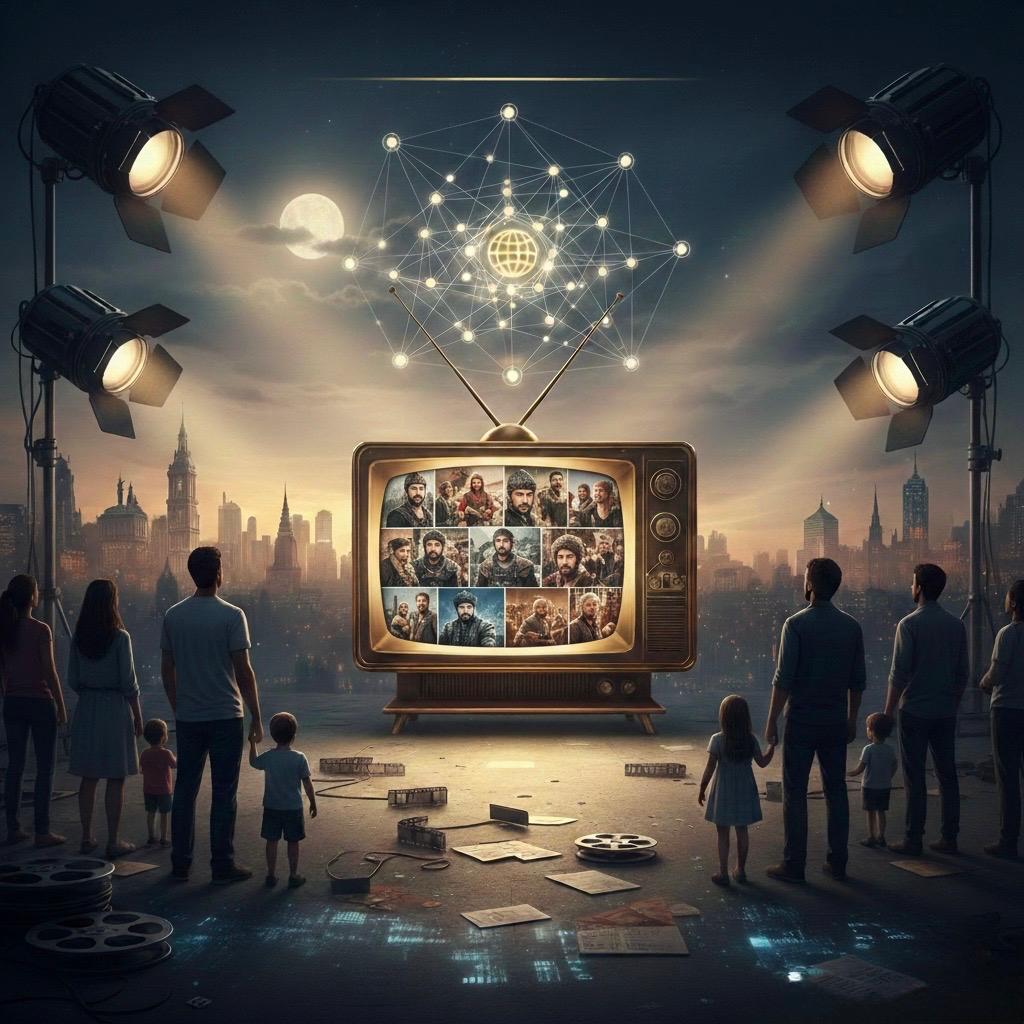
In our changing world, the influence of nations is no longer measured exclusively by the size of their military arsenals. Hard power has receded to make way for softer, more penetrating tools. Turkey realized this truth early on, deciding not to content itself with its traditional role as a military ally of the West. Instead, it sought to chart a new course to reshape its regional periphery, adopting television drama—specifically historical drama—as the spearhead of this project.
We are dealing here with what can be termed an “Empire of the Screen,” where series transform into visual political messages that rewrite history and export a new Turkish identity to the world. The numbers confirm the success of the wager; Turkey has become the second-largest exporter of TV drama globally after the United States. This staggering spread is no coincidence; it is a reflection of a Turkish desire to reconcile with the Ottoman past and use this nostalgia as a bridge of legitimacy to access present-day influence.
By highlighting examples of historical Turkish dramas that formed the backbone of this strategy—such as Resurrection: Ertuğrul, Establishment: Osman, Payitaht: Abdülhamid, and The Great Seljuks: Guardians of Justice—we will investigate how the television set turned into a battlefield. Peoples received these epics with passion, searching for a savior, while official regimes viewed them with suspicion, regarding them as cultural invasion and an attempt to reimpose Ottoman guardianship.
Soft Power and the Formation of Transnational Loyalty:
To understand the secret of this influence that has unsettled regimes and enchanted populations, we must deconstruct the mechanism by which this drama operates. Here, we return to the 1990s, when Joseph Nye introduced the concept of Soft Power as an elegant alternative to the dominance of money and arms; it is, simply put, the art of attraction, or the ability to make others adopt your ambitions voluntarily rather than through coercion. However, Ankara, in its quest to redefine its regional role, did not merely borrow this concept; it radically re-engineered it. It transformed the drama industry from a mere export commodity generating profit into what can be described as a Strategic Force Multiplier, evolving through two decisive turns that reflect shifts in the Turkish political mind.
In the first phase of this story, Turkey played the role of the “Dream Model.” Social dramas like Noor (Gümüş) and Forbidden Love (Aşk-ı Memnu) served as open windows through which the peoples of the region looked upon a lavish Istanbulite lifestyle that combined contradictions: a comfortable Islamic identity and an alluring Western modernity. The villas of the Bosphorus offered the Arab viewer a version of modernity that felt accessible—an image of a state that had reconciled with the West without antagonizing the East.
But the geopolitical earthquakes that struck the Middle East after 2011 forced a shift in both script and direction, ushering in the second and more complex phase: Identity Mobilization. Here, social romance receded to make way for historical epics. Ankara no longer presented itself as a bridge connecting two banks, but as a fortified fortress and the last sanctuary for the Ummah (the Islamic nation).
This functional shift moves us from the square of traditional Soft Power to a more combative space that analysts call Sharp Power. The difference is fundamental; while Soft Power seeks to win hearts through attraction, Sharp Power aims for deep influence on public opinion and the shaping of consciousness.
In works like Ertuğrul and Abdul Hamid, the viewer does not sit before the screen merely for pleasure, but subconsciously engages in a process of conviction reshaping. These dramas redraw the world according to a binary of “Us” (the Nation led by Turkey) versus “Them” (the Western alliance and internal treachery). The most dangerous aspect of this strategy is its ability to create a sphere of emotional influence that transcends geography. It forms a sentimental loyalty that crosses borders, making a citizen in the far reaches of the Islamic world feel that their destiny is organically linked to the occupant of the Presidential Palace in Ankara, superseding their local national loyalties. In short, it is a systematic strategy to recycle memory, transforming historical heritage from archival material into live political ammunition used to settle influence battles in the present.
Maps Without Borders: The Symphony of Ottoman Memory and Dramatic Analysis:
To understand what happens behind the scenes of Turkish drama, we must look beyond the surface of the script to deconstruct the primary engine of the political mind in Ankara: Neo-Ottomanism. This term, which has long sparked controversy, is often misunderstood. It does not necessarily mean moving armies to reclaim old maps; rather, it is an ambitious project aiming to restore spirit and influence within the vital space of the Empire. It relies on the theory of “Strategic Depth,” which refuses to reduce Turkey to the role of a passive transit bridge, proposing it instead as a Pivot State. This vision has been translated visually through an interconnected series of dramatic works that can be read as a graduated manifesto, utilizing history to serve the present through sequential movements:
The Founding Text (Resurrection:Ertuğrul– Diriliş Ertuğrul): This series posits the dialectic of Resurrection versus Extinction. Although set in the 13th century, it brilliantly employed the psychology of nostalgia (“the engineering of yearning”) to treat the feeling of geopolitical orphanhood among Muslim peoples. The work focuses on themes of existential threat and the siege of the tribe, offering a dramatic treatment of the concept of the “Besieged State” that has no choice but steadfastness and self-reliance to wrest justice by force. Here, the tribe became a symbol for contemporary Turkey, and Ertuğrul transformed into the savior model who reconnects the severed glories of the past.
State-Building (Establishment:Osman – Kuruluş Osman): As the narrative matured, the treatment shifted from the obsession with bare survival to the challenges of institutionalization and state-building. The series addresses the difficulties of smelting scattered tribal entities into a single central crucible, directing an implicit message to the Turkish interior about the danger of “multi-headedness.” This shift is read as a dramatic response to questions of the contemporary political system, where the idea is entrenched that rallying around strong central leadership is the historical condition for renaissance. Internal division is portrayed as a strategic danger threatening the structure of the state, legitimizing the perpetual need for vigilance and national unity.
Historical Revisionism (The Capital: Abdul Hamid –Payitaht: Abdülhamid): This central state does not operate in a vacuum but faces complex historical geopolitical challenges. This is addressed by engaging in what is academically known as Historical Revisionism. The work seeks to dismantle traditional Western narratives, portraying the Sultan as a strategic figure defending the unity of the Empire against international plots, clearly highlighting “Sèvres Syndrome” and the deep-rooted anxiety about partition. Here, drama reframes the relationship with the West from dependency to parity, posing legitimate questions about sovereignty and loyalty, and turning the screen into a court that acquits the past to grant confidence to the present.
The Deep State (The Great Seljuks– Uyanış: Büyük Selçuklu): To entrench the deep roots of this vision, the horizon is expanded back to pre-Ottoman times, invoking the concept of Nizam-ı Alem (Order of the World). The work focuses on rooting national security in the face of covert infiltration and asymmetric threats, reinforcing the narrative that views the strong state and its institutional apparatus as the final fortress against chaos.
This dramatic symphony does not stop at historical narration; it extends to create a state of Real-time Intertextuality with hot-button issues in the Islamic world. This was clearly manifested in a precise symbolic scene in Establishment: Osman, when the character Cerkutay used a spoon to free himself from captivity, raising it as a symbol of liberty. The Arab audience immediately read this scene as a clever visual reference to the Palestinian “Tunnel of Freedom” operation (Gilboa Prison, 2021), where a spoon became a symbol of resistance. This employment of contemporary symbols confirms that Turkish drama aspires to represent the pain of the entire Ummah, creating a cross-border emotional unity.
Perhaps the most prominent achievement of this dramatic system is its ability to alter viewing psychology. After decades of acclimation to fast-paced drama (30 minutes), Turkish works succeeded in anchoring the viewer before episodes lasting two hours and exceeding a hundred episodes. The secret lies in the strategy of Immersion; the long duration is not used for filler, but to build a parallel world where the viewer lives with the characters through the minutiae of their daily lives, creating a deep para-social bond that makes watching a ritual of total co-existence.
Ultimately, this integrated system aims to present what scholar Marwan Kraidy calls “Neo-Ottoman Cool”—branding Turkey as a civilizational trademark, allowing Ankara to extend its emotional influence without the need for entry visas, establishing what can be described as an “Emotional Empire” stretching from the Balkans to the depths of Asia.
Between Arab Narrative Rivalry and Asian Historical Depth:
Tracing the trajectory of this drama outside its national borders, we face a complex map of reception where responses vary based on the historical legacy and political context of each region.
First: The Arab World… The Dialectic of Popular Reception and Official Reservation:
In the Arab space, these works created a striking state of contrast. On the mass level, the Turkish narrative achieved a vast presence, attributed by sociological studies to the search to fill a leadership void. The viewer found in these epics a form of Sublimation by invoking images of heroism and justice, in addition to presenting a model of “Conservative Modernity” that combines heritage identity with the quality of contemporary visual production.
Conversely, official institutions and cultural elites in some Arab states viewed this dramatic rise through the lens of cultural security. The reintroduction of the Ottoman narrative in a positive light was seen as a challenge to nationalistic narratives that had settled for decades on criticizing the Ottoman era. This divergence in visions resulted in strategies to deal with this cultural influx, ranging from limiting media broadcasting to intellectual engagement via religious institutions debating the historical content, eventually reaching the stage of creative competition.
The series Kingdoms of Fire (2019) is the most prominent example of this competition. It was presented as a visual document offering a Counter-Narrative focusing on local resistance to the Ottoman presence, rehabilitating historical figures like Tuman Bay. Thus, the media landscape transformed into an arena for visual and historical dialogue, where each side seeks to present its own reading of shared history, reflecting the vitality of cultural and political interaction in the region.
Second: South Asia… From Identity Crisis to Memory Reactivation:
In contrast to the controversy in the Arab world, the reception of Turkish drama in South Asia—specifically Pakistan—was characterized by a type of Cultural Identification. Although some analyses attribute this celebration to a search for an alternative identity distinct from the Indian legacy, a reading of modern history reveals deeper and more entrenched dimensions to this connection.
The relationship between the Muslims of the Indian Subcontinent and the Ottoman Center is not a product of contemporary drama but rests on solid historical infrastructure. The Khilafat Movement (1919-1924), which launched from India, is the most prominent witness to this solidarity, constituting the largest global popular movement supporting Turkey’s independence at that time. Ties were not limited to political solidarity but were reinforced by high-level social bonds, exemplified by the historical intermarriage between the Nizam of Hyderabad’s dynasty and the Ottoman House, when the Ottoman Princess Dürrüşehvar Sultan married Prince Azam Jah, the son of the most powerful Muslim prince in India.
Therefore, the momentum Turkish drama enjoys in Lahore or Karachi today cannot be read merely as the importation of a foreign culture or an attempt to imagine a new identity. It is more academically accurate to describe what is happening as a process of Memory Reactivation. The drama acts as a visual catalyst summoning a latent historical and sentimental reservoir of shared relations. The South Asian viewer does not see the “Turkish Other” on the screen, but an extension of alliances, lineages, and a shared history of struggle against colonial powers in the last century.
Between the Arab wariness based on competing national narratives and the Asian embrace based on recovering shared memory, Turkish drama succeeds in transforming history from rigid archival material into a vital geopolitical actor. It redraws the mental maps of the region, proving that the artistic image, when grounded in shared cultural heritage, possesses a superior ability to transcend geographical borders and address the collective conscience of peoples.
Sustaining the Impact: From the Economics of Drama to Digital Sovereignty:
If historical narratives represent the intellectual content of Turkish soft power, the economic and technological infrastructure represents the vessel ensuring its continuity and spread. Indicators suggest this industry no longer relies solely on the spontaneous success of artistic works but has gradually transformed into an integrated Ecosystem combining cultural production with economic returns, granting it the ability to adapt to global market variables.
The first features of this institutionalization are evident in the economics of drama; TV production has turned into a vital export sector. Official data indicates steady growth in series export revenues, providing financial flows that are reinvested to raise Production Value. This sustainable economic model allowed production companies to invest in elements of visual attraction—from massive sets to meticulous costume design—maintaining the global competitiveness of the Turkish product in a market dominated by high production standards.
Parallel to direct revenue, an indirect impact emerged: Nation Branding. Tourism studies show a positive correlation between the spread of drama and the influx of tourists wishing to explore the spatial settings of these works. Filming locations and Ottoman historical sites have transformed into global points of attraction, reflecting the drama’s success in converting Symbolic Capital (history and culture) into Material Capital (tourism and consumption), in a promotional process that exceeds traditional advertising campaigns in impact.
To ensure the independence of this cultural flow, Turkish media strategy has recently moved toward bolstering Digital Sovereignty. The launch of international streaming platforms, such as (Tabii), represents a fundamental shift in distribution mechanisms. In the age of digital streaming, these platforms allow for bypassing traditional distribution channels and regional intermediaries, securing Direct-to-Consumer access to the global audience. This step is read not only from the angle of technical expansion but as a mechanism to ensure the flow of cultural content in isolation from geopolitical fluctuations or censorship restrictions that traditional TV networks in certain regions might impose.
Conclusion: The Horizons of Soft Power and the Limits of the Image:
In sum, the Turkish dramatic experiment offers a striking model in studies of communication and public diplomacy. By marrying the allure of historical narrative with infrastructure efficiency, it has succeeded in building a cross-border cultural presence, contributing to proposing an alternative narrative to cultural globalization that restores regard for Eastern values and symbols in the global collective imagination.
However, this media success faces objective limitations. Political analysis suggests that the excessive employment of direct messages may sometimes lead to counterproductive results, stimulating cultural immunity in targeted societies or provoking rival national narratives. Furthermore, Soft Power, no matter how great its influence, remains governed by the equations of Hard Power and complex economic and political realities.
Ultimately, Turkish drama remains a rich case study proving that the small screen is no longer merely a means of entertainment, but has become a main arena for shaping perceptions. It demonstrates that the ability to tell a story and possess the tools to disseminate it is a fundamental pillar in shaping international standing in the twenty-first century.